

SHOP HERE
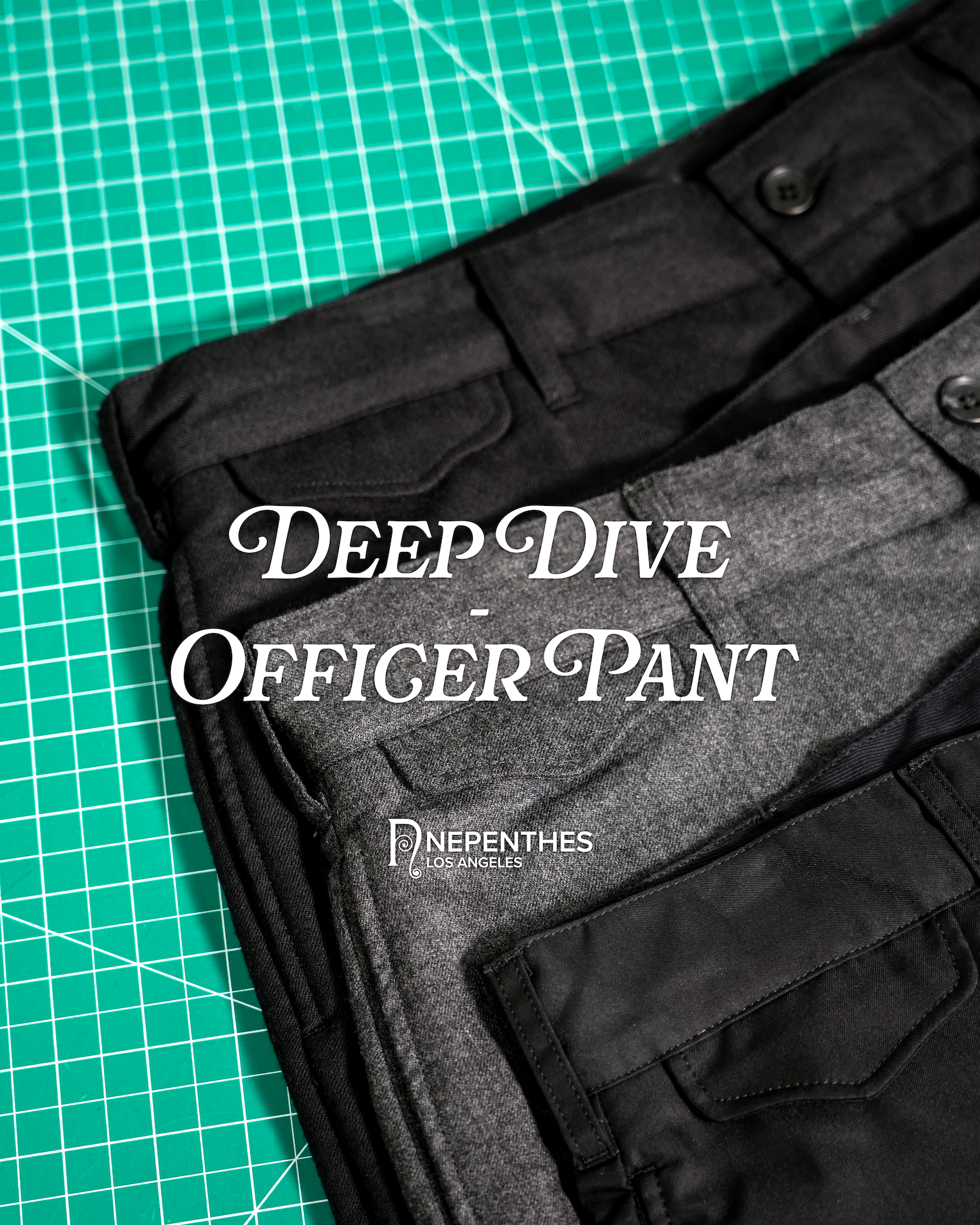
Welcome back to “DEEP DIVE,” where we explore the inspiration behind some of our favorite pieces from Engineered Garments. In this edition we spotlight the “Officer Pant,” a wide-legged trouser drawn from the khaki working uniform worn by United States Navy officers during the Second World War.


Khaki entered the Navy through aviation. Before 1941 the khaki working uniform was limited to naval aviators, approved for commissioned officers, warrant officers and chief petty officers who were flying or performing duties directly related to flying. It consisted of a combination cap with a khaki cover, a coat, a shirt with a black necktie, trousers and brown shoes.
In the spring of 1941 the Navy authorized it throughout all of its branches, for commissioned officers, warrant officers and chief petty officers alike, and what had been aviation dress became the practical summer working uniform of the fleet. The cloth was khaki cotton, either twill or drill, recognizable by the raised diagonal ridges in the weave. A lightweight tropical wool version followed in the fall of 1942, its coat lined in rayon where the cotton one had been left unlined.
The trousers were cut for movement, and the regulations were specific about the result, calling for the bottoms of the legs to measure between eighteen and twenty-two inches in circumference in a cloth matching that of the coat. They were made with a button fly, two front and two rear internally hung pockets, and a watch pocket set below the right side of the waistband.
Unlike the comparable Army and Marine Corps officers’ trousers, the Navy pattern carried no flaps over the rear pockets, though the left rear pocket closed with a button through the pocket itself. Early in 1943 the Navy began procuring khaki trousers built to Army specifications in order to ease the burden on the garment industry, and the substitutes can be told apart by their canted front pocket openings, their simplified waistband and the absence of the button on the rear pocket.

The Officer Pant keeps a good deal of the original, including the watch pocket and the generous cut through the seat and thigh, along with the wide leg the Navy’s regulations called for. The changes made are mostly practical ones. The button fly has been replaced by a zipper, and rear darts have been added to give the pant a more natural shape over the seat. The rear pockets and the front watch pocket have gained flaps, a detail borrowed not from the Navy but from the flapped rear pocket of British battledress trousers of the same period, which keeps the pant within a military vocabulary.
Since its introduction the Officer Pant has been one of the most popular items in the Engineered Garments lineup, and it now runs through the collection year round in fabrics the Navy never had occasion to specify.
