

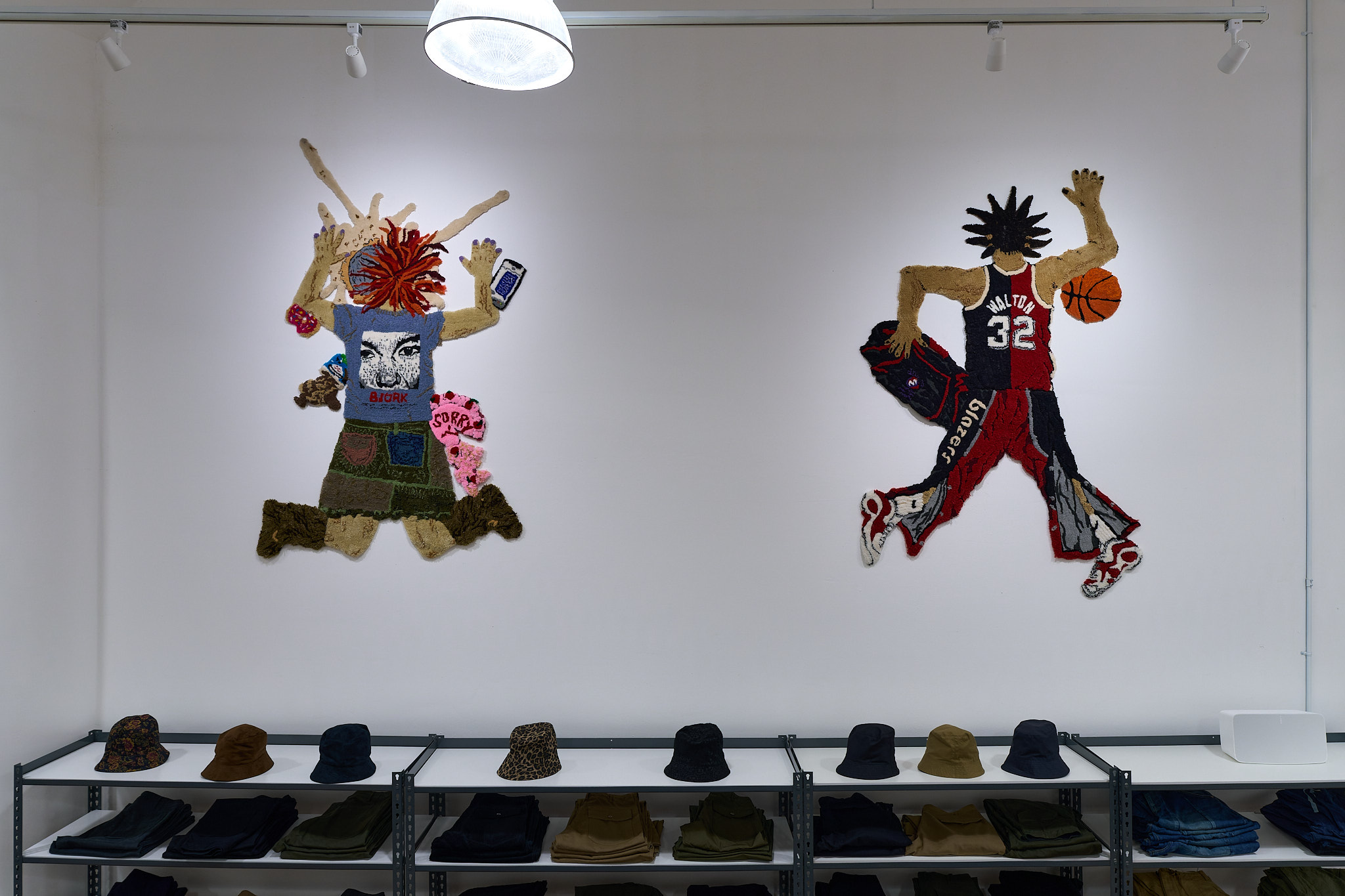
Your journey as an artist seems deeply personal. How did it all begin for you, and what led you to discover tufting as your primary medium? Was there a specific moment or experience that made you gravitate toward textiles?
It was and it wasn’t. It sort of came about from a crafty hobby. A lot of people disassociate craft from fine art, or there is this sort of odd relationship between the two. Anyways, it was a hobby until it wasn’t. I believed the work I made began to depict a deeper and meaningful purpose, in which that transition occurred. I am grateful for that. Technically, any sort of craft can be considered.
In past interviews, you’ve mentioned being part of a tufting “renaissance” and learning the craft DIY-style. How has your self-taught background shaped your approach to art, and how do you view the tension between traditional rug-making techniques and your more experimental, political work?

Hm, not much difference other than the work I make is truly an ode to the laborers of the skilled trade. Technically, I am doing what they do, there really is no difference in between. I think the only difference here is the narrative of the work. The act of tufting depicts a rich meaning, although the design or the image of what is created in an industrial setting may not be. I think being self-taught pushed me to become curious and eager to perfect the trade as they do industrially. I am aligning myself with those processes, and so it is working backwards in a way which I find a bit unusual!
Your work often balances the humorous and the serious, especially regarding social and political critique. How do you approach this balance, and what role does satire play in your storytelling?
I think everything is funny and should be funny. It sounds dumb and even makes me cringe but comedic relief is important to my life and so I hope to implement in the work as well.
In many of your pieces, you challenge perceptions of art and labor. How do the materials you use—whether sourced locally from small businesses or industrial suppliers—play into the more significant messages you aim to communicate through your work?

This is a hard question to answer because it is comparable to asking why a painter may use acrylic over oil and vice versa. I use both acrylic and wool in the work that I do. I think given the economic and social conditions of the world we live in, not every artist can afford the best material to create their work, but given the status of my life (I am by no means well off, I would consider myself a working artist from a working class background) I do my absolute best to source quality material for the work that I do or at least sustainable in some ways whether that be utilizing second hand merino or acrylic yarn. I think the same could be said for materials used in clothing. For a brand like Nepenthes, even in the early stages, I am sure these were and are things that the team is constantly thinking about. And by “thinking about” I just mean the ethical and practical decisions made for garments and textiles in general.
Your subjects vary widely—from LA Dodgers references to Monster Jam trucks to political commentary. How do you select these themes, and what drives you to focus on specific cultural or social elements in your pieces?
I would say cultural relevance in terms of the way we engage with the media every day. I am solely driven by doomscrolling, or relevancy to contemporary phenomena we see on the internet. I love memes and checking twitter and “archiving” them on my phone. I go back and look at these things (screenshots on my phone) whenever I want to consider a new idea for a piece. That is what helps it all come together, which again, feels a bit embarrassing to type out but it is what it is. I am a zillennial after all, it’s what we do.
Unlike traditional gallery pieces that exist at a distance, your art is designed to be lived with—stepped on, and interacted with daily. What does this level of physical interaction add to the experience of your art, both for you as the creator and for the viewer?
The work I make are inherently considered rugs, so I would like for them to play the role of the rug if ever the opportunity arises. I love messing with the installation of the works, which we sort of attempted to do at Nepenthes (a bit conservative due to the layout of the space, it really differs from place to place). As a creator, it is the purpose of the piece as I am thinking about the trade of tufting. From the spectator, I guess that is up to them to image and draw conclusions towards!
You’ve lived in Los Angeles for a while now. How does the city influence your work, both in terms of its cultural energy and your personal experiences here?
I think it’s a very unusual place. I love it here and have been in Southern California my entire life. There is a mystery to this city that only coming and living here could provide answers to.
How did your collaboration with Nepenthes come about, and what has this experience been like for you? What’s on the horizon for you, both in your art and life?

Well, if I’m being honest Beni asked me to be part of the show and I obliged. On the other hand (if we are thinking more conceptually) I believe showing textiles above textiles is a unique dichotomy. Because below we see textiles being sold commercially, and above we see textiles installed as an art form. The two are in my opinion co-existing, while also swapping roles. Art is indeed sold commercially as well, and garments are considered art forms too!