

SHOP HERE
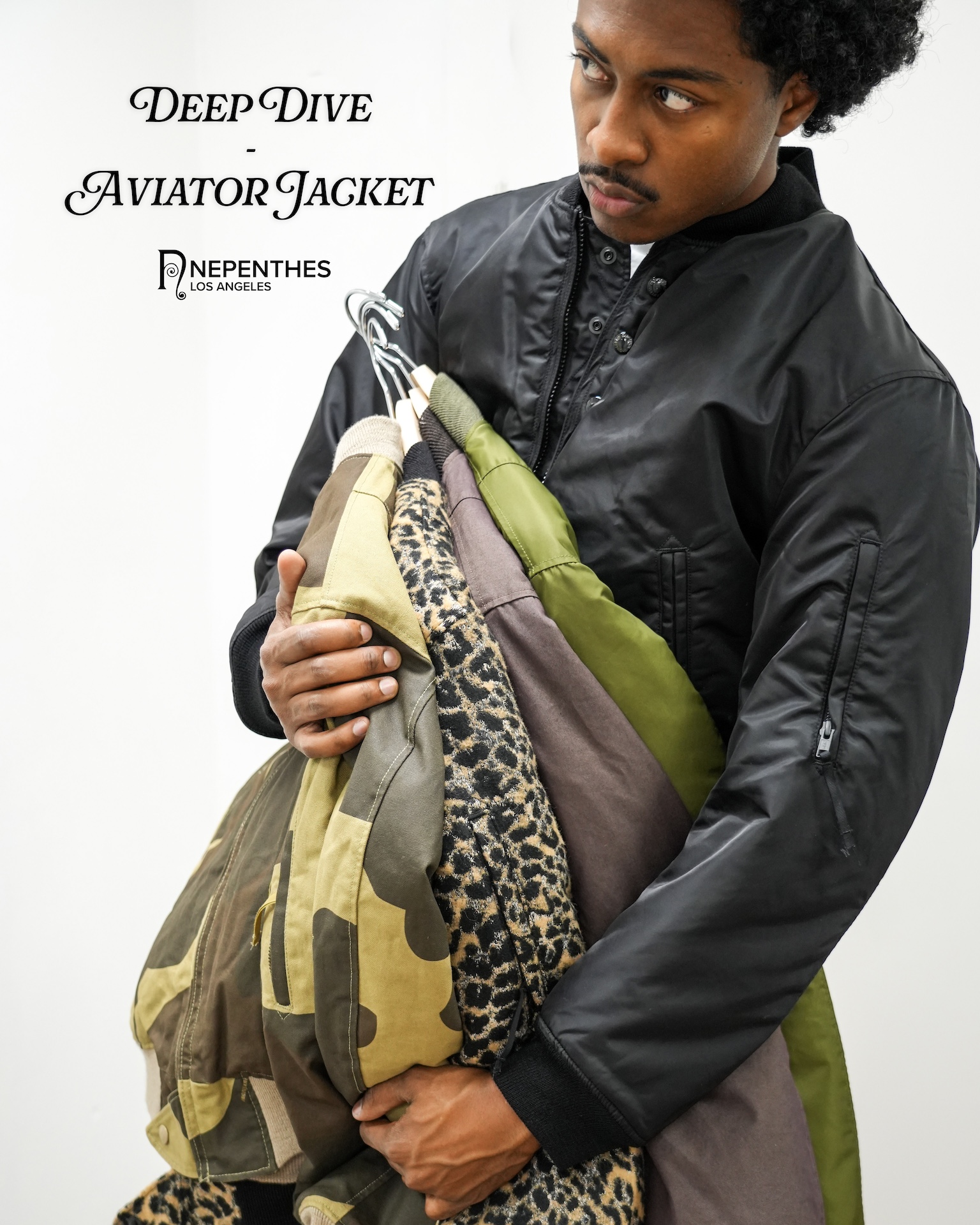
Welcome back to “DEEP DIVE,” where we look into the inspiration behind some of our favorite Engineered Garments pieces. In this installment we are featuring the “Aviator Jacket,” the Engineered Garments version of the modern flight jacket.

For the first half of the twentieth century, the standard American flying jacket was made of leather, and the A-2 and G-1 remain the two most recognizable examples. Leather was heavy and slow to dry, however, and by 1943 a wartime shortage of hides had pushed the Army Air Forces to downgrade the A-2 and move toward cloth. The B-15 arrived the following year with the proportions that flight jackets have kept ever since, including a short body, wool knit cuffs and waistband, a mouton fur collar inherited from the jackets before it, and a narrow pocket set high on the left sleeve for pens and pencils, which was the first appearance of a detail that has remained on the garment ever since.
The move away from leather accelerated with the arrival of the jet engine. Chuck Yeager took the Bell X-1 past the speed of sound on October 14, 1947, less than a month after the Air Force had separated from the Army to become its own branch, and within a few years the piston-engine fighter was gone from front-line service. Jet cockpits were tighter and colder than the bombers the earlier jackets had been designed around, and they were full of new equipment, so a mouton collar that had been perfectly practical in 1944 now interfered with the flight helmet, the oxygen mask and the parachute harness.

The collar was accordingly cut down to a band of wool knit, and the resulting jacket, the MA-1, was adopted in 1953 under military specification MIL-J-8279, with the lighter L-2B covering milder conditions under a specification of its own. The shell was DuPont nylon 66, which was wind resistant, water repellent, quick to dry and difficult to scuff or tarnish, while the interlining was a wool pile grafted onto a cotton mesh backing, an arrangement that held until polyester fiberfill replaced it toward the end of the 1970s.


By the early 1960s the lining had been changed to a bright orange so that a downed crewman could reverse the jacket and be seen from the air. Alpha Industries, incorporated in Knoxville, Tennessee in 1959 and sewing for the military from the outset, took its first MA-1 contract in 1963 and has been associated with the jacket ever since.
The Engineered Garments Aviator Jacket draws on all of these. The low standing collar, the elastic cuff, the sleeve pocket sized for pens, pencils and a pack of cigarettes, and the hourglass quilting inside the lining are all borrowed from the run of jackets the US military commissioned through the middle of the century.
Its closest relative, however, is the CWU-7/P, a less familiar garment built to specification MIL-J-38183 and issued to Air Force aircraft maintenance crews from the mid 1960s through the 1970s. Because it was made for the flight line rather than the cockpit, it was cut from cotton twill rather than nylon, lined in cotton sateen, interlined with a quilted gauze and polyester padding, and fitted with four slanted front pockets in place of the two found on an MA-1. The details that most clearly mark the Engineered Garments version are drawn from this jacket, in particular the tab at the throat and the straight waistband, which replaces the elastic hem that a flight jacket normally carries. Original examples are difficult to find today, largely because the crews who wore them spent their shifts in grease and jet fuel.

A love letter to these military garments, the Aviator Jacket stands on its own. This season it is offered in Flight Satin Nylon in Black and Olive, the fabric closest to the military original, as well as in Brown Mammoth Duck Camo Canvas, Brown CP Weather Poplin and a Brown Wool Poly Leopard Jacquard. Whatever the fabric, the wide shape and roomy cut of the jacket make it easy to layer over a vest or a hoodie as the fall weather approaches.

Available at Nepenthes Los Angeles, Nepenthes Woman Los Angeles, and online at nepenthesamerica.com.