

Fifteen years ago, Amelia Haru pulled into her parking spot at 6 a.m., home from a long night at the office. As she parked, her boyfriend came out of their apartment carrying a surfboard, headed for the water before his own workday began. She watched him go, bright and early, off to do something he loved, and a single thought arrived with total clarity: I want to be that happy. Soon after, she told her boss she was quitting to do something creative. She did not yet know what creative meant. She only knew she had to make room for it in her life.
That morning divides Haru’s life into a before and an after. The after, slow and nonlinear and still unfolding, now hangs on the walls of Nepenthes Woman Los Angeles: thirty-some watercolors and prints of girls, cats, oceans, and night skies.

Haru grew up twice. The first childhood took place in Setagaya, Tokyo, in an apartment that faced a small farm, since swallowed by development, where she lived until she was ten. Her father is American, her mother Japanese, and international school took care of her English early. What no school could prepare her for was the move itself. When the family relocated to Southern California, she discovered that speaking the language of her new classmates was not the same as sharing a world with them. She loved manga, anime, and Japanese pop stars; they had never heard of any of it. Among her chief anxieties about immigrating, alongside whether she would make friends at all, was a question she remembers with complete seriousness: Will I be able to read the rest of Sailor Moon?
The manga obsession had a precise origin. In second grade, her grandmother took her to a bookstore and told her to pick one out, any one. Haru chose the volume with a cute cat on the cover, and was hooked from then on. She read shojo romances and took notes on her own future: someday I will fall in love, and this is what it will be like. She spent her second childhood, the American one in La Crescenta, drawing her favorite characters in her room and dreaming of becoming a manga artist, sustained by trips to Little Tokyo. “Thank goodness it was LA,” she says.
As an adult, she has a theory about why manga, of all things, held her so completely. The medium is vast. In Japan there is a manga about everything, and none of it is fenced off as children’s entertainment. But the deeper reason is what it asks of its reader. Unlike anime, manga supplies no voices, no motion, no tempo. The reader imagines the sound of each character, animates the action between panels, sets the pacing with the turn of a page. “It’s kind of the artist and the reader having a conversation,” she says.
Hers was a creative household built on practical ground. Her mother is endlessly curious, the kind of person who follows an interest wherever it leads: writing, illustration, flower arrangement, building websites. Her father, a writer and lifelong musician, still practices piano every day; her brother is a musician too. Creativity was everywhere in the house, but it rested on a foundation of responsibility, and the lesson she internalized was that stability came first. She absorbed it thoroughly enough that when she reached college, she decided art was not a real job and did not study it. Then, almost without noticing, she stopped making it for nearly a decade. She drifted between majors at UC Irvine before landing on Japanese language and literature, which everyone told her was equally impractical. It was simply the only subject that interested her enough to stay.
The degree led to a manga publisher, where she helped coordinate the localization of Japanese titles for American readers and first found her way into translation. Then came the video game industry, PR, events, and the long hours that ended in that 6 a.m. parking spot.

Following the dramatic exit, paralysis set in. In the beginning she sat in the park, zoning out like the salarymen who cannot bring themselves to tell their families they have lost their jobs. “I could do everything,” she recalls, “and I didn’t know where to start.” She read scheduling books, built routines that collapsed, and gradually learned something unflattering and useful about herself: she does not run on self-imposed structure. She runs on external deadlines, on being accountable to someone or something outside her own head.

Again and again since then, her career has moved forward when something outside herself demanded work from her. When she applied to the craft fair Unique LA, the application required a product line and a shop she did not have, so she invented one: mocked up the merchandise, submitted it, got accepted, and then made everything she had promised. When she needed a constant, it became the calendar she has now produced for ten consecutive years. Twelve paintings, ready each October, gifted annually to her grandmother, stocked by a handful of stores that have come to expect it. There have been lean years when those twelve paintings were the only art she made. Even so, the calendar has quietly done more for her than any strategy. It led to teaching. It has earned her fans in far-flung places, too. During the current show, a visitor appeared at Nepenthes because her brother had been buying the calendars for years, and left determined to collect whatever else existed. Haru describes her path with a borrowed image she loves: dots that connect only in hindsight. “Whenever I make plans, they seem to explode into flames,” she admits. “The path kind of appears as I go.”

The work itself required a different surrender. Haru will tell you, a little ruefully, that she is an earthy person. Dark tones, serious tastes, someone who would never wear pastels. But when she stops supervising herself, what comes out of the brush is bright, dreamy, and soft: girls and cats, blossoms and moons. The second grader who picked a manga for the cat on its cover is, all these years later, still holding the pen. For years the gap between the artist she imagined being and the art that actually arrived frustrated her. Lately she has stopped fighting it. “If you want to keep making art, just do what comes through,” she says. “Apparently, my heart is filled with girls and cats.”
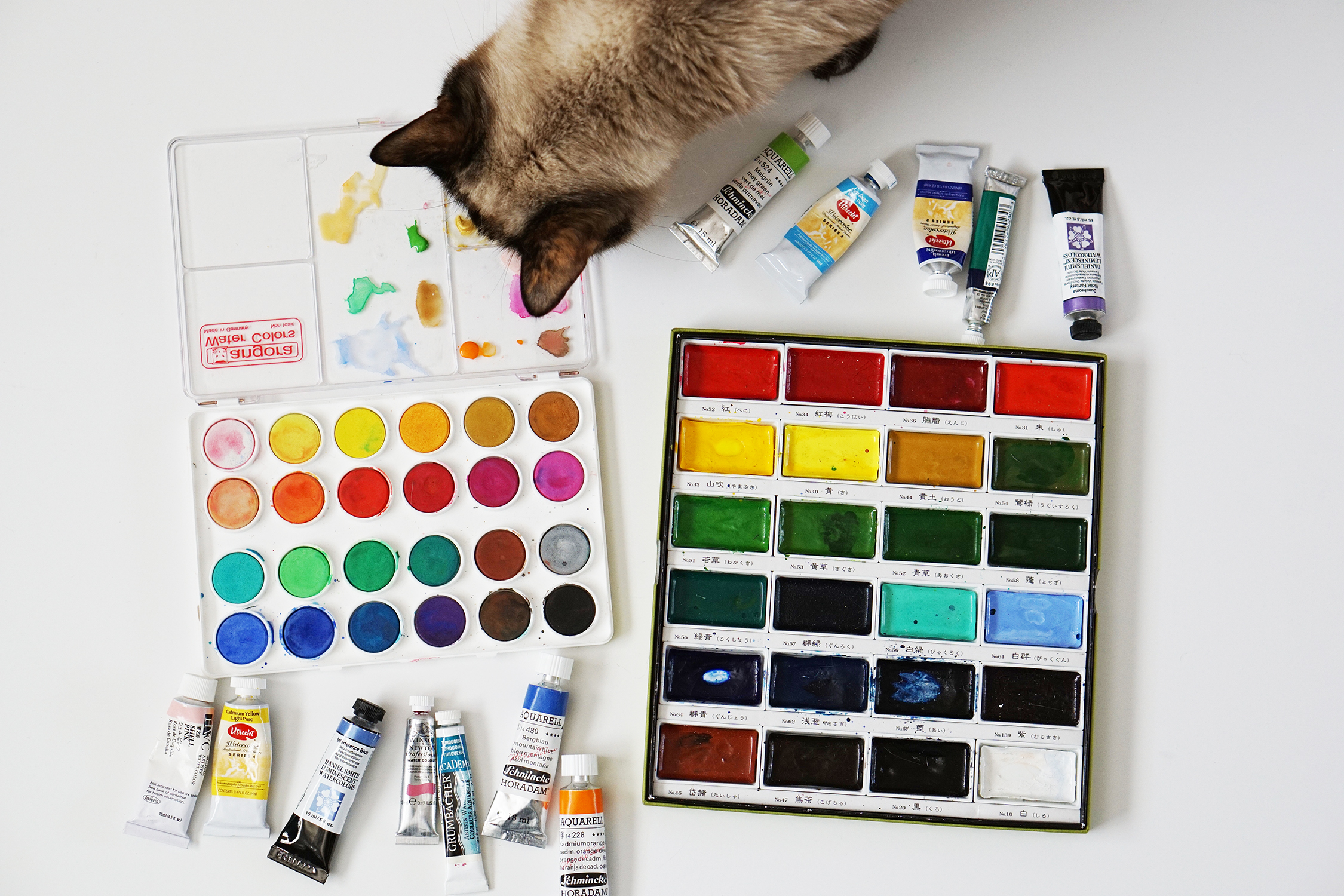
Last year tested all of it. A steady job of four years came to an end. A health issue led to surgery and a recovery period that kept her from doing much of anything. And her cat died, a loss that hit harder than she had imagined. She knew what grief could do to her work; there had been losses before that stopped her from making anything at all. This time was different. One day she sat down to paint her cat, expecting it to hurt, and found it calmed her instead. She remembers the sound of the brush tinkling in the water glass. Painting, it turned out, could be part of the healing rather than a casualty of it. There was still a practical fear in the way. She had spent the past several years leaning heavily into digital work, where deadlines are safer and every mistake can be undone, and she worried that analog work would fail her, that pieces would not turn out or would not finish on time. There is no undo in watercolor. She went back to it anyway, in a year when nothing could be undone, and started small. At the top of this year she was making blobs: holding the brushes, testing colors, asking nothing of the results. She was rebuilding her strength, as she puts it, along with her body.


She also knew the blob chapter would not last, because she knows her own internal clock. A routine holds her attention for a month, three at the most, before the novelty drains out of it. Right on schedule, the play stopped being enough. “I wanted to make more cohesive thoughts,” she says. “Complete sentences in my art, instead of just blobs.” At that moment the invitation from Nepenthes arrived: a real deadline, a beautiful room. For someone who runs on external structure, the timing could not have been better. “For the first time,” she says, “art felt like tending to myself.” Not pushing, not groping around in the dark.
The show at Nepenthes Woman is those complete sentences, framed. The watercolors are intimate in scale, the smallest just five by seven inches, and their titles read like a diary of the year that produced them: “New Beginnings.” “One Small Step.” “Space to Grow.” “With You Always.” One painting, “Dot to Dot,” names her entire philosophy of a career and hangs there as proof of it, already sold. Because she cannot visualize a finished painting in advance, each one is made the way she reads manga: as a conversation. “The painting wants to go this way or that way,” she says. “I just kind of see it as I make it.” She finds this fun and scary at the same time. She reaches for similar words when she talks about the watercolor workshops she began teaching last year: scary, but the right kind of scary. “Teaching about something,” she says, “is the ultimate form of learning about it.”
Haru has given up on knowing her purpose. Not on having one, but on knowing it. “I decided it’s none of my business to know what exactly I’m here for,” she says. “Maybe on my deathbed, I’ll look back and be like, oh, that’s how the dots connected.” For her this is a freedom: permission to keep following whatever calls, the calendar, the teaching, the next painting, trusting that the pattern is forming even when she cannot see it. She thinks sometimes about the version of her life without any of it. “I would just be in my room alone reading manga,” she says. Instead, every piece she puts into the world seems to widen it a little: a workshop, a collector, a conversation like this one. The show, she says, has set her in motion. “My engine is running.”
There is one more dot, still unconnected. Among the first works to sell were two small paintings titled “Surfer Cat,” a Haru character paddling out, doing the thing she watched from her parked car fifteen years ago. She has still never surfed. She says she is finally going to try.

