

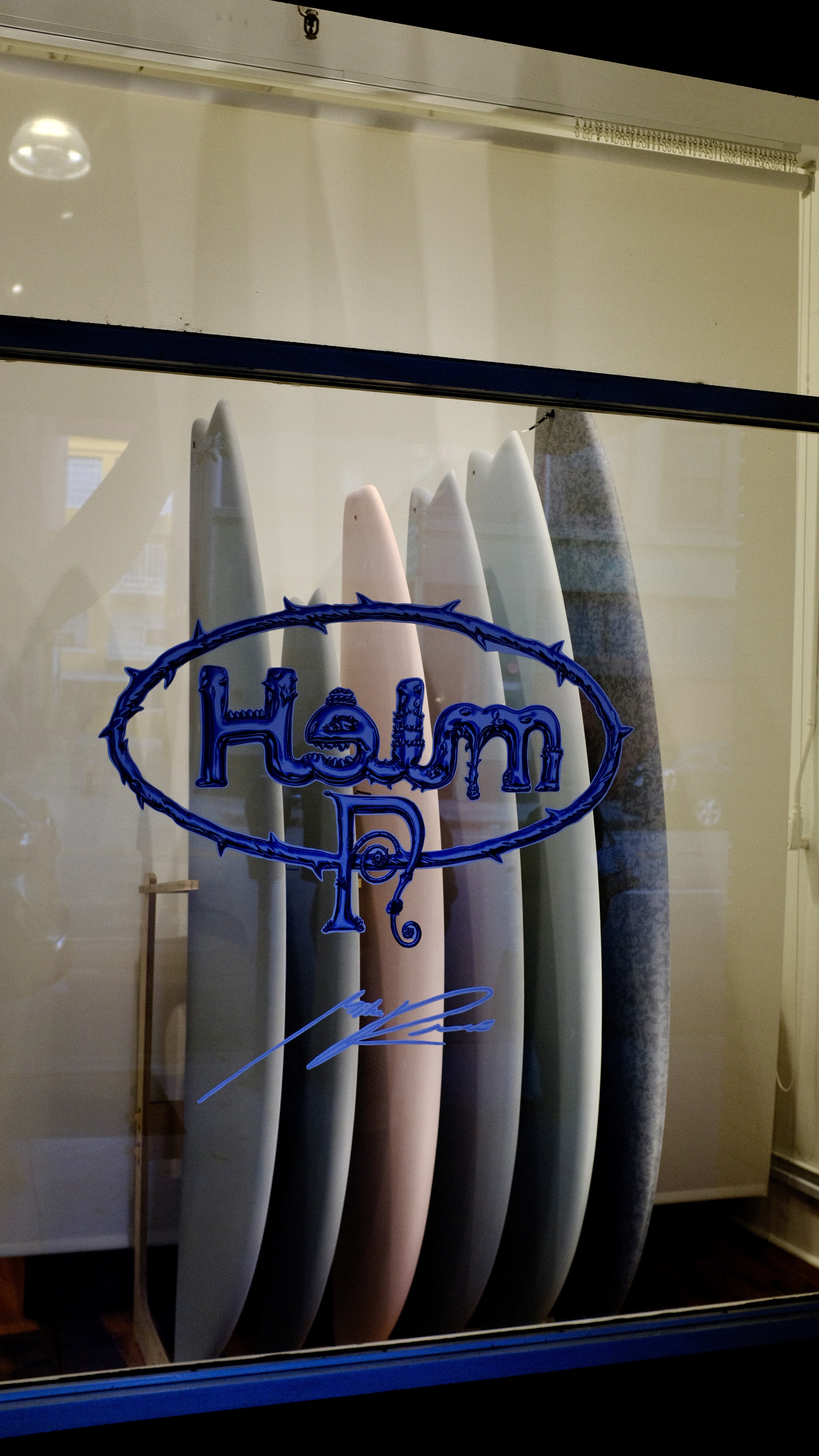
Inside Nepenthes Los Angeles, the collaboration between H3LM Supplies and Mike Reesé does not announce itself as either a surf pop-up or a traditional art exhibition. It feels more open than that. A surfboard sits alongside sculptural objects, apparel, and a wall of magnetic letters. People stop, touch, rearrange, spell something out, leave a message, erase it, and begin again.
The project is called “Full Time Human”. Direct but not didactic, it asks a simple question: in a world increasingly shaped by screens, automation, surveillance, and optimization, what does it mean to remain physically, emotionally, and imperfectly present?

For H3LM, the answer begins outside. The Los Angeles-based company began during COVID, when Giuseppe Valentini and Yuichi Ishii became fascinated by the idea of manufacturing surfboards for people seeking movement and escape, with Hitoshi Saito joining soon after. Working with legendary shaper Clyde Beatty Jr., H3LM’s boards strike the balance between approachable and serious. The hybrid construction means soft EVA traction, no wax, lighter handling, and added safety. They are not designed around fantasy conditions or professional performance; rather, they are made for the reality of Southern California, where waves are often imperfect, and the best board is sometimes the one that lets you catch more waves and have more fun.
That grounded, humanistic approach is also what makes the collaboration with Mike Reesé feel natural.
The collaboration between Mike and H3LM developed in a similarly human way, beginning through existing relationships. Yuichi and Mike had known each other for years through LA’s creative circles, and when the opportunity with Nepenthes came up, the connection felt natural.
Reesé’s work moves between painting, graphic language, storytelling, and world-building. Growing up in Mid-City Los Angeles, he first came to creativity through community. As a young teenager, he was around friends who were already making things, starting projects, and building small worlds of their own. His first outlet was graphic design and T-shirts, shaped by the energy of LA streetwear and the Fairfax era. Painting came later, during his time at Otis College of Art and Design.
In his first formal painting classes, Reesé began to understand that his visual voice could already hold its own. The dense graphics, screen-printing instincts, maximalist compositions, and symbolic systems he had developed through T-shirts carried into his paintings. Rather than separating design, art, and commerce into different categories, he let them overlap.
For “Full Time Human,” one of the key points of connection was Reesé’s alphabet. In his world, letters are not only letters. They belong to what he calls the “26 tribes of Alpha Beasts,” with each character carrying its own virtue, emotion, or part of the human experience. A becomes fortitude. B becomes fertility. The alphabet becomes a coded system, expanding beyond language and into feeling.

The centerpiece of the “Full Time Human” is a metal sheet, placed inside Nepenthes Los Angeles and adorned with magnetic letters designed by Mike. Here, his language system becomes physical. It asks people to participate, leaving a message, a joke, or a jumble of letters behind. The work becomes a small public forum, voiced by the people who touch it.

By breaking down the distance between artwork and viewer, the piece gives people permission to communicate physically. In a moment when so much communication is mediated through screens, there is something deeply human about watching someone spell out a thought by hand, one letter at a time.
The rest of the art exhibition references AI, surveillance, technology, and the artificial. The chrome surfaces and security camera elements gesture toward a colder, more mechanical world. But the project offers an answer: interaction, touch, humor, and error. It urges the viewer to make something, together, if only briefly.


The project began with intimacy, and that is what it projects outward. H3LM brings the language of outdoor life, surf culture, and practical design. Reesé brings a symbolic universe built from emotion, memory, and play. Nepenthes Los Angeles gives those worlds a physical meeting place.
Together, they create something that resists easy categorization. It is a pop-up, an exhibition, a product collaboration, and a social space. But more than anything, it is a reminder that objects can still invite presence. A surfboard can be a tool, an artwork, and a record of a place. A letter can be a symbol, a toy, and a feeling. A shop can become a temporary gathering point.


