

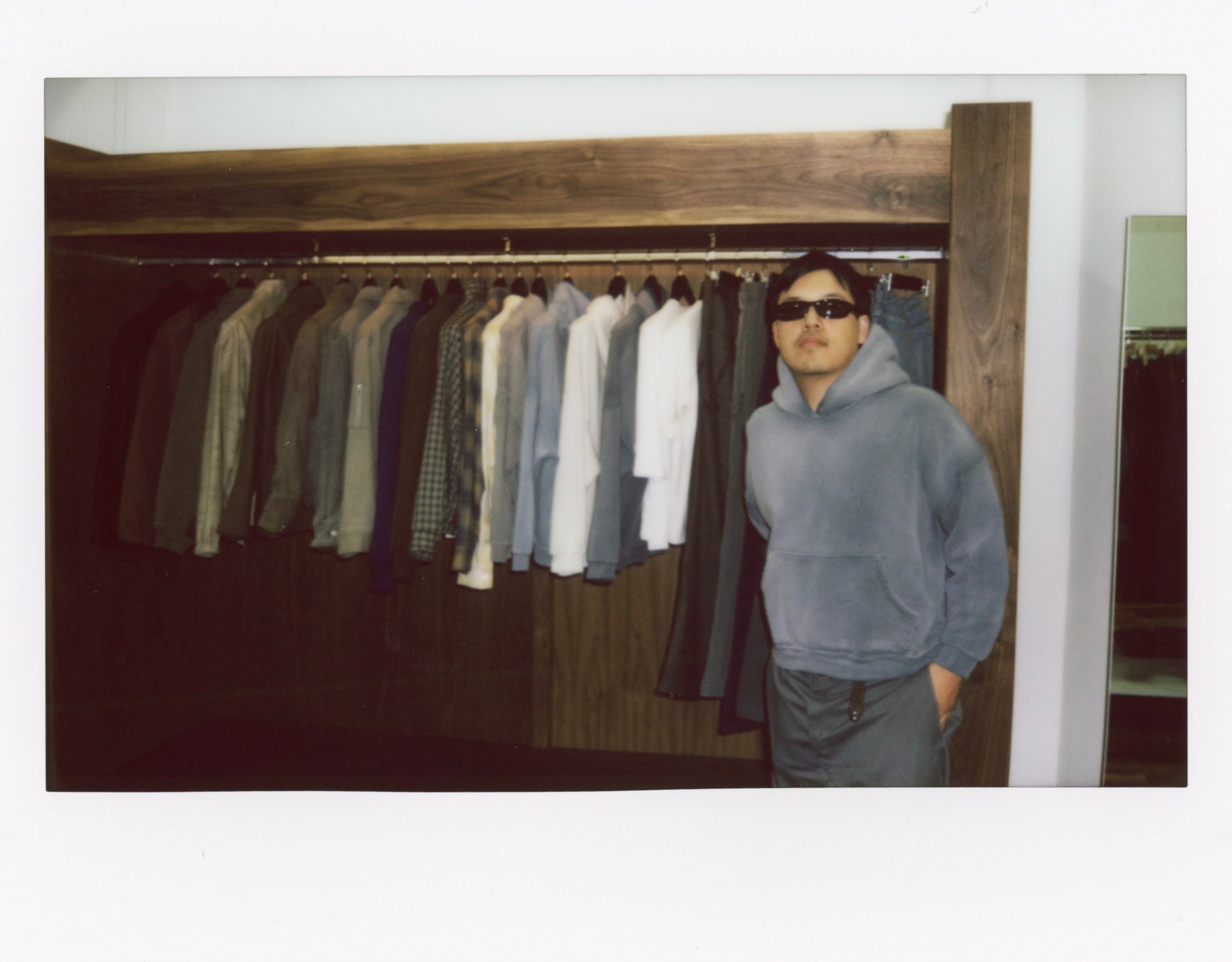
SHOP HANGOUT FOREVER HERE
Profile on Antwan Vu
Antwan Vu sits in a tight beanie, long-sleeve tee, jeans, and a pair of Vans he found at Saver’s, which he describes as just the “right” object, a clear winner among the flotsam of discount footwear. That idea, finding the right item in a sea of options, recurs throughout his label Hangout Forever, which currently occupies the pop-up space at Nepenthes Los Angeles.

For the past five weeks, he has been preparing for the installation with near-manic focus, making daily pilgrimages to cutting rooms, sewers, snap specialists, and dye houses across Downtown Los Angeles. He speaks of the manufacturers he works with as family. The operation is almost entirely a one-man show, and he proudly pulls up spreadsheets detailing cost margins, production volumes, fabric choices, and due dates. All of the clothing is made in Downtown Los Angeles, something he admits one would have to be at least a little delusional to undertake. Recently, he secured a place in a Paris showroom, where he will travel in June to exhibit the collection for the first time, opening the work to wholesale orders and a larger stage.
He carries himself like someone who knows that no one else will realize the dream for him. The result is a visible exhaustion, held up somehow by genuine excitement at the chance to put his ideas into the world.

Vu’s entrée into fashion came through a kind of osmosis. Born in Chicago and raised in San Diego, he grew up in a tight-knit Vietnamese-American family. Skateboarding became his chief interest, and with it came an early aesthetic education: Andrew Reynolds, Jim Greco, Jason Dill, Terry Kennedy, Baker, Deathwish, the whole visual and emotional vocabulary of skate videos. He filmed his friends, learned to observe through a lens, to pair a song with footage, and to build atmosphere through editing. Chicago played its role as well. Summer visits with relatives led to trips to Bucktown and first encounters with stores like St. Alfred and RSVP Gallery, at an age when the store experience can permanently reshape the brain. Yes, there was the selection of clothing itself, but also the incense burning, the arrangement of the racks, the attitude of the staff, all of it unlike anything in his daily life, and all of it revealing clothing as something larger than product.
Often, the line between remaining a fan of clothing and becoming a designer is crossed the moment one gains the ability to transform clothing oneself. Vu’s aunt, a seamstress, taught him how to do exactly that. After she developed breast cancer, he spent time with her as a way of keeping her company through chemotherapy treatments, and in turn, she taught him how to sew, how to hem pants, how to take things apart, and how to understand proportion from the inside. It is difficult not to see this as one of the true beginnings of Hangout Forever: not simply a love of clothes, but a growing ability to intervene in them, to correct them, and to bring them closer to what they ought to be.
For a country as vast as the United States, New York is often seen as the only American city that fully commands the fashion establishment’s respect. So why make clothing in Los Angeles? In many ways, Los Angeles remains misunderstood, perhaps because of the glare cast by the entertainment industry and the ease with which the city is flattened into cliché. As Vu puts it, “People who visit LA might not like it, but the people who live here love it.”
He arrived here after graduating in 2019 and took a backstock position at Opening Ceremony, a job that became an informal capstone to his fashion education. He still speaks reverently about Dries Van Noten Fall/Winter 2019, which was in the shop when he first joined. At Opening Ceremony, he had his first real opportunity to handle clothes of that caliber closely, to examine them, try them on, and ask questions. Admiration quickly became ambition. He did not just want to wear these clothes. He wanted to make something of his own.
“I can’t imagine a world where I am not at the factory every day,” Vu says. Downtown Los Angeles, despite appearances, remains home to a dense ecosystem of clothing manufacturers, and the Fashion District is still very much alive. Vu insists that “you can find new spots every day if you wanted to.” He describes many of these factories as “pre-internet,” by which he means not backward, but familial, relationship-driven, and still operating according to older forms of trust, intuition, and specialization. Raised in a family-centered environment himself, he responds naturally to that world. More importantly, he believes it can produce almost anything.

Nepenthes Los Angeles chose to be downtown for related reasons, embracing a neighborhood that can be overlooked or dismissed and finding there the space to articulate a distinct voice. Vu finds it fitting that his clothes should make their first retail appearance in the same neighborhood where they were made.
But what of the clothing itself? Here is where Vu’s particular gift comes into focus, not flamboyant invention, but calibration. His talent lies in recognizing when a garment has crossed over from interesting to right.
He describes the process behind Hangout Forever as “just making clothes.” Coming from someone else, that phrase might sound evasive. Here it does not. The mechanism begins with daily life, then works outward, searching for the garment that can carry a whole day while retaining both utilitarian purpose and emotional resonance. He often returns to a line raised in conversation between Miuccia Prada and Raf Simons: “A piece of clothing serves the rule of making you live better… it has to be useful.” Unnecessary features fall away. Innovation for its own sake holds little interest. He compares the bond one forms with a garment to the relationship one has with a car: something used every day, something that has to feel right. A pair of jeans that can follow you to work, to dinner, and out into the night.

Inspiration might come from a piece he owns, something glimpsed on the street, or an object discovered almost by accident. At the moment, he is studying military parkas. He scans garments for details, guided by a curiosity and an intuitive feel for what works, noting where proportions might shift, where a pocket should be removed, where a zipper should be added. Sometimes a project begins with fabric, which he typically sources from Italy or Japan. From there, he lets an image of the thing he wants gather in his mind and allows that image to guide the piece into being.
Perhaps the clearest example of his method is the Airloom Hoodie, which took countless iterations and an extraordinary amount of time to perfect. Vu spent years hunting for the right brushed jersey fleece before finally finding a Japanese mill producing fabric on salvaged Italian loopwheel machines that had been shipped to Japan and restored. From there came further refinements in proportion, the precise shoulder drop, the width, the overall balance. Even the dye treatment emerged from experimentation at a dye house, an accidental result he recognized as right and chose to keep.


Hangout Forever is not made in competition with anything, nor does it submit neatly to the rules of any one genre. The luxury price point was never the goal so much as the place Vu arrived when he insisted on making things his own way. Like composing a song, he chooses which elements deserve to remain and which are extraneous. He hopes the customer experiences the garments in much the same way: returning to them again and again, discovering something new, taking pleasure in the slow process by which a piece becomes familiar, softens, settles, and wears in.

That idea brings the story back to where it began. The “right” object is not simply the thing that stands out at first glance; it is the thing that continues to reveal itself through repeated use. In that sense, Hangout Forever is not simply a project about making clothes in Los Angeles, or even about making beautiful clothes. It is about the harder task of making clothes that can earn a lasting place in someone’s life.
